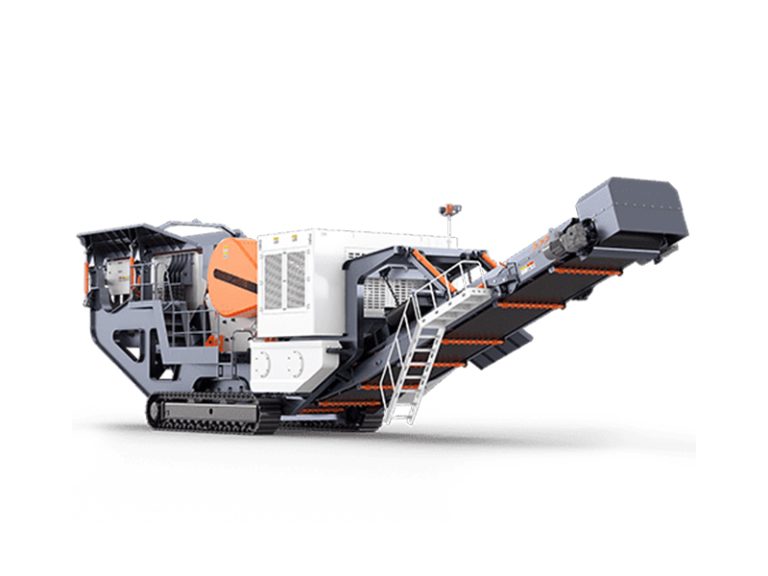
A track-mounted mobile jaw crusher is a mobile crushing equipment that integrates crushing, feeding, and conveying functions. It features
a track chassis design, allowing it to move independently and operate directly at the work site without requiring fixed foundation installation.
Compared to traditional fixed crushing equipment, it’s like a mobile crushing plant, completely transforming the traditional model of mining crushing operations.
Core Advantages: Why choose a track-mounted mobile jaw crusher?
Flexible Mobility, Convenient Relocation
The track-mounted mobile jaw crushing plant is equipped with a heavy-duty track chassis, possessing strong load-bearing and climbing capabilities. It can move stably on rough, soft, and slippery road conditions, with a maximum climbing angle of up to 20°. The equipment uses wireless remote control operation, allowing for on-the-spot turning and climbing. It doesn’t require flatbed truck transportation; it can be driven directly to the work site, and relocation and deployment can be completed in just one hour.
Integrated Design, Cost Savings
The equipment adopts an integrated unit design, combining crushing, feeding, and conveying functions. This eliminates the complex site infrastructure installation required for separate components, eliminating the need for foundations, and allowing for immediate operation upon arrival at the site. Compared to traditional fixed crushing production lines, it saves significant civil engineering costs and installation time, improving overall efficiency by more than 40%.
Strong Processing Capacity, Adaptable to Various Materials
The track-mounted mobile jaw crusher can crush various hard rocks, such as granite, basalt, limestone, and construction waste. The feed size can reach 400-1000mm, with a processing capacity of 100-450 tons/hour. The discharge opening is hydraulically adjustable to meet the needs of different finished product sizes, producing various specifications from 0-50mm to 50-100mm.
Intelligent Control, Convenient Operation
The equipment is equipped with a PLC intelligent control system, enabling one-button start/stop, remote monitoring, and fault diagnosis.
Operators can view the equipment’s operating status, production data, and maintenance reminders in real time via a touchscreen. It supports wireless remote control operation, reducing manual intervention and improving work efficiency and safety.
Energy Saving and Environmentally Friendly, Compliant with Standards
It uses a hybrid power system (oil and electricity). When sufficient fuel is available, it priorities electricity; in areas without electricity, it automatically switches to diesel power, saving more than 25% in energy consumption. Equipped with a pulse dust removal system and noise reduction design, the dust emission is ≤20mg/m3 and the noise level is ≤75dB, meeting global environmental standards.
Application Scenarios: Which fields are suitable for its use?
- Mining
Directly deployed to mining areas for crushing operations, reducing raw material transportation and lowering transportation costs.
Particularly suitable for multi-stage mining and open-pit mining operations, increasing production efficiency by more than 40%. The equipment can be driven directly to the mining face, crushing large pieces of ore into medium-sized materials, which are then transported to a fixed production line by dump trucks, significantly improving loading rate and transportation efficiency. - Construction Waste Recycling
In urban renovation and building demolition, the equipment can efficiently process construction waste, crushing concrete, bricks, and other
construction debris on-site to produce recycled aggregates. The recycling rate of construction waste can reach 95%, turning waste into valuable resources and contributing to green building and the development of a circular economy. - Road and Railway Construction
The equipment can quickly provide high-quality stone materials to meet the aggregate needs of infrastructure construction such as highways, railways, and bridges. In mountainous areas, plateaus, and other complex terrain conditions, it can directly produce sand and gravel aggregates at the construction site, ensuring project progress. - Sand and Gravel Aggregate Production
Suitable for crushing and processing river pebbles, granite, basalt, and other stone materials, the particle size and output can be flexibly adjusted according to market demand. It replaces traditional fixed production lines, flexibly responding to market demand fluctuations and improving corporate competitiveness.
Frequently Asked Questions (FAQ) - Does the crawler-type mobile jaw crusher require a foundation?
No. The crawler-type mobile jaw crusher adopts a crawler chassis design, allowing it to move independently without the need for a fixed
foundation. It can start working immediately upon arrival at the site, significantly saving civil engineering costs and installation time. - Can the equipment operate normally in areas without electricity?
Yes. The equipment is equipped with a diesel generator set. In areas without a power grid, it can be powered by the diesel generator set,
enabling rapid commissioning in the early stages of the project. In areas with a power grid, it can also be powered by an external power source, effectively reducing operating costs. - What should be paid attention to during equipment maintenance?
Routine maintenance should focus on lubrication, fastener inspection, and wear of vulnerable parts. The equipment is equipped with an automatic centralized lubrication system, making maintenance more convenient. Regularly inspect the wear of vulnerable parts such as jaw plates and liners, and replace them promptly when the wear exceeds 30%.
Selection Suggestions
When selecting a crawler-mounted mobile jaw crusher, the following factors should be considered: - Material properties: The hardness, particle size, and moisture content of the raw materials determine the selection of the equipment model.
- Production capacity requirements: Select the equipment model with the corresponding capacity based on daily or hourly output.
- Finished product particle size: Determine the required specifications of the finished product and whether a return system needs to be
installed. - Site conditions: Select equipment of appropriate size based on the production site area.
- Budget range: Equipment prices range from hundreds of thousands to millions of yuan; the selection should be based on the investment budget.